


Boys Town celebrates an Irish Christmas at Father Flanagan’s house
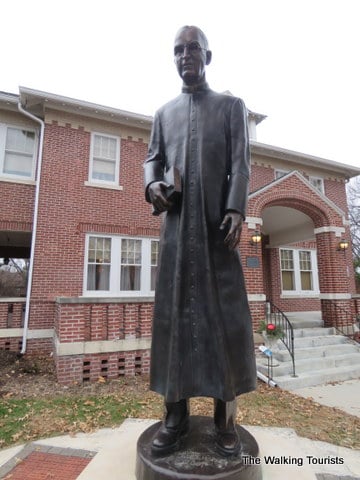
The Rev. Edward Flanagan – better known as Father Flanagan – was proud of his Irish heritage. The founder of Boys Town is recognized annually with an open house during the holiday season at the house he occupied for 14 years of his life.
Father Flanagan was born in 1886 near the village of Ballymoe in Galway, Ireland. He arrived in the United States in 1904. He studied at Mount St. Mary’s University in Maryland. After attending St. Joseph’s Seminary in New York, he was ordained as a priest in 1912. This happened after further study at the University of Innsbruck, Austria.
Father Flanagan’s first assignment was in O’Neill, in northeast Nebraska. Soon after, he was assigned to an Omaha parish. It was in Nebraska’s largest city where he would make the greatest impact of thousands of lives.
Father Flanagan founded a home for homeless boys in downtown Omaha in 1917. He didn’t have the full support of church leadership for his endeavor, but his success proved the program worthwhile. It started with a few boys, then grew. He didn’t focus on helping girls at the time, because he believed they would find homes or employment as maids, etc.

His boys home relocated to a farm a few miles west of Omaha (now, Omaha surrounds the area). Boys Town was founded in 1921. It grew from a farm with a school and dormitory to a small city with a student mayor, schools, chapels and family homes.
Father Flanagan lived in a small house next to “Old Main,” the original administration building. He resided in the house 1927-41, when he moved into the rectory.
The house is open for tours, but during the holiday season, it’s decorated to reflect an “Irish” Christmas in honor of Father Flanagan. Visitors are given a brochure that highlights the Christmas decorations used for the season.
During father Flanagan’s residency, guests would gather in the reception room before meeting with him. This room features paper decorations in red and green hanging from the curtain rods. Three candles are lit on Christmas Eve to represent the Holy Trinity. Holly is also located throughout the room.

The parlor was used by Father Flanagan and his family to celebrate the holidays. They’d gather around the fireplace and celebrate with stories and song.

The parlor is decorated with Holly and greens. Paper decorations (created by children) hang from the windows. Red candles in the window were lit on Christmas Eve to welcome the Holy Family. The table is set with candy, fruit and a special punch (for adults). A nativity scene would be situated on the fireplace mantle.
The dining room was prepared to host the most important dinner of the year – Christmas Day dinner. The table had beautiful China and silverware arranged in front of each chair. A silver coffee set sits atop the buffet, next to the Coinneal Mor na Nollag candle.

The room was decorated with green and red paper decorations, as well as Holly and greens. Red candles would be located in the windows.
As you can imagine, the kitchen would be a busy spot during this time. Following the traditional December meals, a special meal is prepared on Jan. 6th. It’s called Nollaid na mBan (Little Christmas). Mothers were given the day off from cooking. The family would prepare the meals and let her rest.

The kitchen table was decorated during our visit to represent a dinner setting on Christmas Eve to welcome the Holy Family. A dish is left on the window ledge to be blessed by the Holy Family.
As I mentioned, the original house was small. Father Flanagan’s sister, Nellie, was the housekeeper. Her bedroom was located across from the kitchen, near the back of the house. Her room features paper decorations, Holly and greens, as well as a red candle in the window.
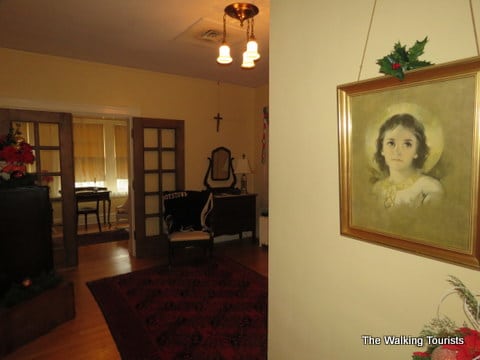
The staircase to the second floor is also decorated with greens and ornaments. At the landing is a cross.

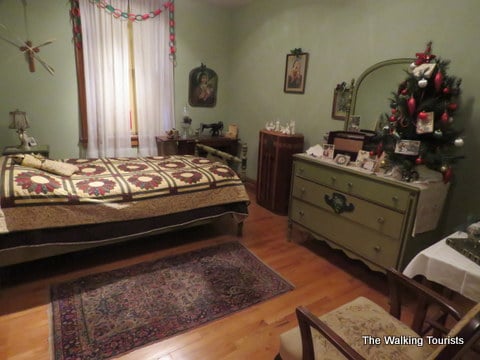
The second floor had Father Flanagan’s bedroom, as well as two others – one used by his nephew, who helped run Boys Town, and another used by guests and dignitaries. Baseball legend Babe Ruth was among the guests to sleep there.

The rooms features Holly and greens, as well as paper decorations. A red candle was placed in each room’s window.
Father Flanagan used his bedroom primarily as a dressing room, as well as for bathing.
He spent most of his private time in his study (which features some of his own fixtures). Since he would stay in the room until late, he slept in a single-sized bed in a small room off of the study.
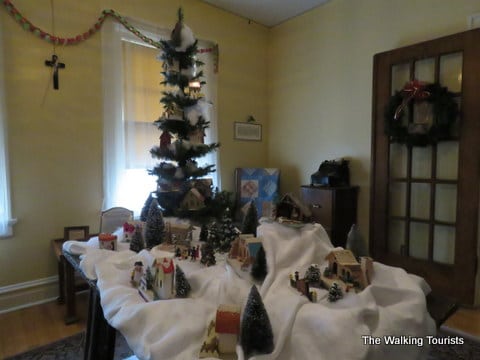
The study featured a small Christmas tree and decorative houses, as well as paper decorations and a wreath.
After Father Flanagan moved to the rectory in the early 1940s, an addition was made to the house. This was done to make room dormitory space – among other things. It now helps to continue telling the history of Boys Town.
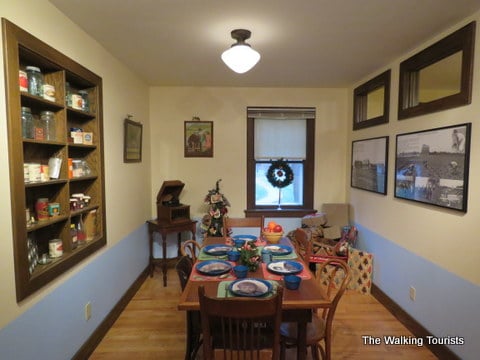
A dining room exhibit highlights the efforts taken to raise food and feed up to 200 boys during the 1920s. Old photos of the farm adorn a wall with a short essay life during that time. On another wall, canned items represent food from the era.
A meditation chapel is located across the hall. The chapel served as the spiritual center for Catholic students during the Christmas season. The chapel has stained glass windows with Catholic symbols engraved. A nativity scene is located at the altar.

Father Flanagan maintained an office in the addition. A manual typewriter and Dictaphone are located there. A lot of alumni joined the military after graduating from Boys Town. A wall features pictures of some of them.

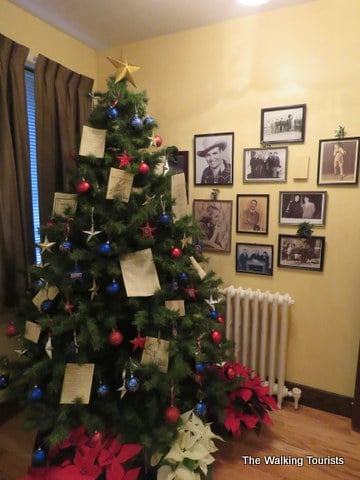
A Christmas tree features letters from some of the servicemen as ornaments. Behind the tree are pictures of celebrities, some with messages to the priest and Boys Town residents. They include Bette Davis, Gene Autry and Babe Ruth.
A 1920’s classroom is available for visitors to check out. A paper Christmas tree is located in the corner. Children would create paper garlands, chains and ribbons to decorate the classroom.

During the early days of Boys Town, the kids would decorate their homes with lit trees and train displays. On Christmas Day, Father Flanagan would distribute gifts to each boy.

A room was set aside for religious visitors during the Christmas season. The room was decorated simply.

A large room was used a dormitory for boys. We saw nine beds in the room, and two sinks.

The room had a pretty decoration in the window. The window was fogged over a bit. I thought it enhanced the holiday season for the visit.

A short walk from the house is a status of the famous “He’s not heavy. He’s my brother” statue. We had to visit it.

Next to it was a Menorah for the Jewish students.

We had a wonderful time visiting father Flanagan’s house. This was our third visit to Boys Town. We visited the Heritage Center and Stamp Center on previous occasions. We recommend visiting Boys Town throughout the year for its history, as well as during the holiday season.
For more information on Boys Town and its attractions, please visit www.boystown.org.

January 2, 2023 @ 7:22 pm
I was there in1960 when I came to the USA. Beautiful place and maybe I can get back.